
Conclusion
How many label feeders to equip has only an indirect relationship with the number of placement machines. What really needs to be calculated is three quantities: the number of label specifications on machines simultaneously, the number of specifications to be pre-installed before changeover, and the number of spare units reserved for replacement. The number of placement machines only determines whether there are enough feeder stations, not how many to buy. There is another thing that changes the total — dedicated models are locked per machine, while standard models can be allocated among machines of the same specification. Only after the ratio between the two is settled does the total become meaningful.
First Count the Label Specifications On Machines
One feeder station on a placement machine holds one feeder, and one feeder corresponds to one type of reel label: width, length, and backing paper arrangement together constitute one specification. So the lower bound is easy to calculate — classify all labels in the BOM by these three items, and however many groups result, that is at least how many feeders are on machines.
Narrow labels of the same width can use a multi-column structure, with one feeder covering multiple feeder stations. LFSID-100 covers 1–14 columns, LFS-60 covers 1–12 columns, and LFFUJI-32 is single-column (values taken from the model summary table). With more columns, the output of one reel is distributed across multiple lanes, occupying fewer feeder stations; the cost is that label width and tape direction must fall within the range allowed by that model’s body, and if oversized, a larger model is required.
Most lines first roughly classify by width, then look at length and material within the width. Feeders of different widths cannot be shared — this is a hard boundary.
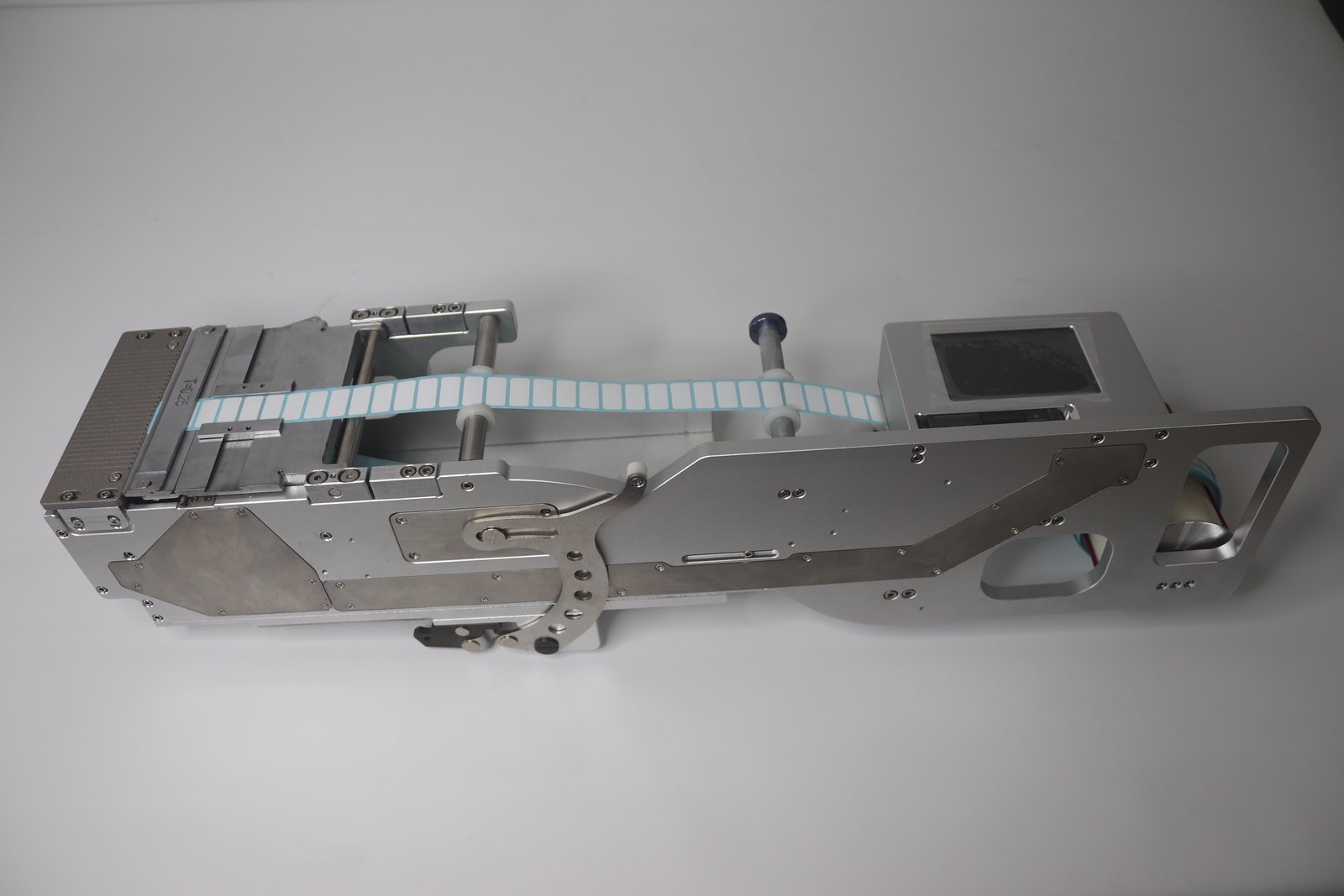
The image shows an actual label feeder (for JUKI machines), with the reel mounted at the rear of the body and the peeling and feeding mechanism at the front.
Then Calculate What Needs Pre-installation Before Changeover
For high-mix low-volume lines, changing over several times a day is normal. During changeover, removal and physical installation must be completed at the machine, while loading and part number verification can be done in advance on the workbench — the prerequisite for doing it in advance is having a second set of feeders: the labels needed for the next batch are already loaded and verified, and the whole unit is swapped in during downtime.
This part does not need to be fully equipped by specification. According to your own changeover rhythm, pre-install one unit each for the few specifications with high switching frequency, and load and verify the rest on the spot — investment and benefit are balanced in this segment. Dedicated models cannot be borrowed across batches because they can only be used on designated machines; standard models can be temporarily allocated among different machines, covering one batch first and then replenishing purchases.
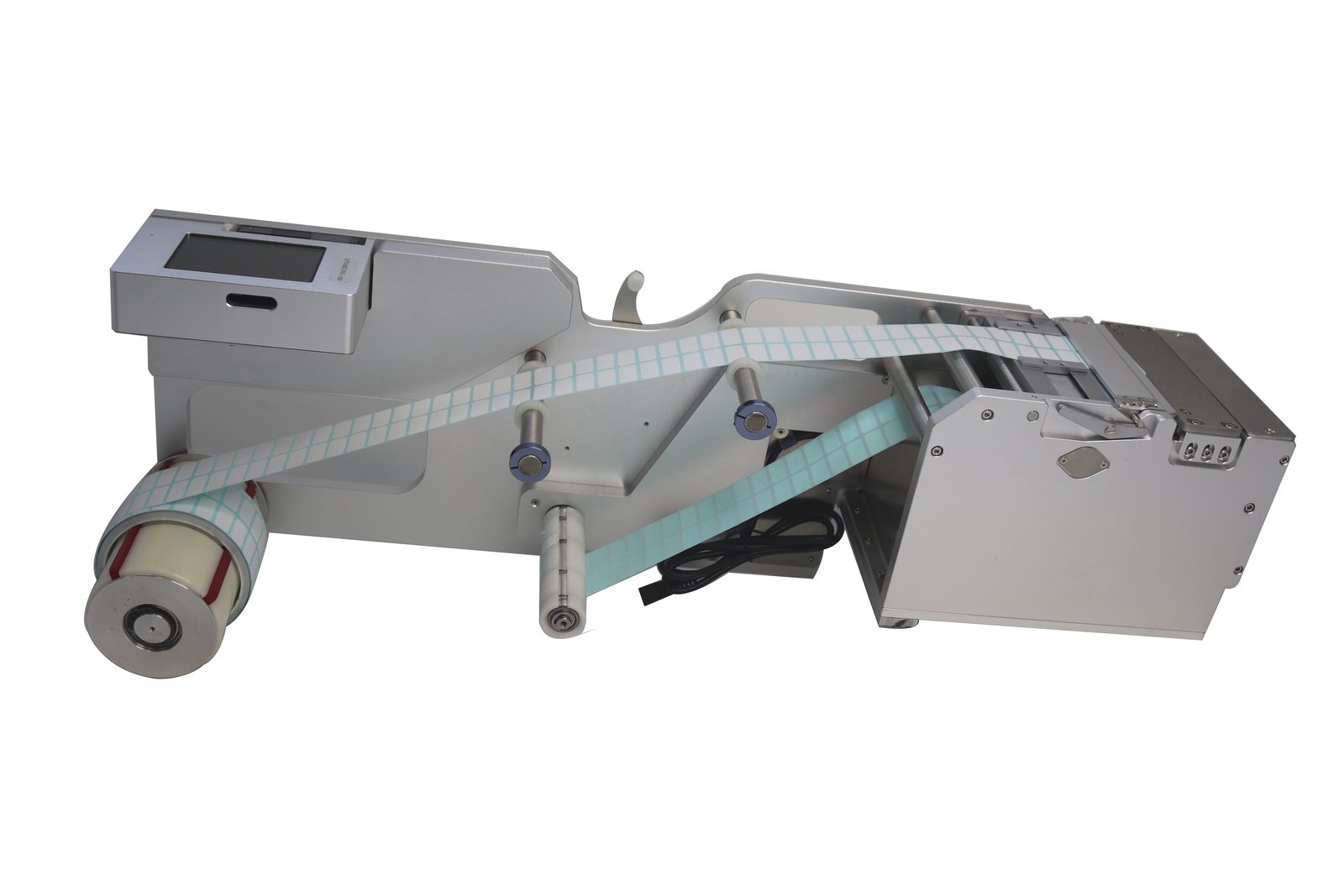
The image shows an actual label feeder (for Samsung/Hanwha machines), with a model identification label on the side of the body.
How to Determine the Number of Spare Units
Spares serve two purposes. One is fault replacement: for a label that cannot stop for even a day, keep one unit of the same model in stock, swap it directly when it fails, and use the repaired one as the spare. The other is process trial installation: when trial-running new backing paper or new materials, use a feeder of a common specification as a stand-in and return it after the trial. Feeders for trial installation do not need to be purchased separately — they can be drawn from the pre-installed batch.
The number of spare units does not need to be scaled up proportionally by specification. Labels with high actual line-stop cost usually account for only a minority of the total specifications; listing “the ones that cannot afford to stop” saves more than allocating by percentage.
An Example Calculation
Below is a set of example data to illustrate how the addition works; it does not represent conclusions for any site.
| Item | Quantity | Description |
|---|---|---|
| Placement machines | 3 units | Same brand, consistent interface |
| Label specifications on machines | 12 types | After classification by width × length × material |
| Feeders on machines simultaneously | 12 units | One per specification, single-column structure |
| Changeover pre-installation | 4 units | One each for the 4 frequently switched specifications |
| Critical label spares | 2 units | Two labels with high line-stop cost |
| Total | 18 units | Excluding trial-installation borrowing |
If 6 of them are replaced with standard models that can be moved among the 3 machines, the 4 pre-installed units have a chance to be reduced to 2 — the total lands around 16 units. How much to reduce depends on whether you are willing to spend extra time aligning positions and resetting fibers during changeover.
Five Numbers to Verify Before Purchasing
- Brand and model of each placement machine: determines whether to use dedicated or standard models, and also determines wiring and signal methods;
- Number of available feeder stations: whether labels compete with components for feeder stations; if competition is severe, consider a multi-column structure;
- Label specification list: width, length, backing paper arrangement, material, listed item by item, including auxiliary materials such as adhesive tape and insulating sheets;
- Changeover frequency and pre-installation batches: how many times per day, how many label types per batch;
- List of labels that cannot afford to stop: these determine the number of spare units.
Among these five, item 3 is easy to miss. Labels are not just barcode stickers; reel materials such as Mylar tape, dust-proof mesh, and reinforcing steel sheets also occupy feeders and feeder stations. Miss one type, and you will be short one unit after purchase.
Three Things After Configuration
Once the quantity is settled, three things remain on site: how to verify feeder station positions, how to set fiber detection, and how to arrange pre-installation. If these three things are not done well, the extra feeders purchased merely occupy more warehouse space. Feeder station positions must be verified according to body dimensions, fiber setpoints must be read in the no-material state plus a margin, and pre-installation must match the workbench layout and batch scheduling.
Configuring quantity is a one-time matter; these three things are daily matters.
FAQ
Q: Can dedicated and standard models be installed on the same placement machine at the same time? A: Yes, provided both are within the adaptation range of that model and the feeder stations and signal channels do not conflict. When mixing, fix dedicated models at commonly used positions and place standard models at positions with frequent changeover, so they can be removed as a whole unit.
Q: Are multi-column feeders always more cost-saving than single-column? A: This holds only when label width and backing paper direction both fall within the range allowed by that model. Once width is exceeded, a larger model is required, and both unit price and body dimensions change accordingly — at that point multi-column may not be cost-effective.
Q: Should spare feeders be reserved one per placement machine? A: Not necessary. Spares are calculated by “labels that cannot afford to stop,” not by machine. If the same specification label runs on multiple machines, one spare unit is enough for turnover.
For more models and structures, see label feeder product line; for how to arrange pre-installation, see Shorten Changeover Time with Feeder Pre-installation.