
What it is
The PLF series feeds die-cut sheet material from a backing-paper magazine instead of a reel. It is built for parts that do not come on roll, or for jobs where a reel is impractical.
Two things separate it from the reel-fed range: it carries a magazine rather than a reel spindle, and it is driven by a combination of electric and pneumatic motion. It can run as a standalone unit or linked to a line.
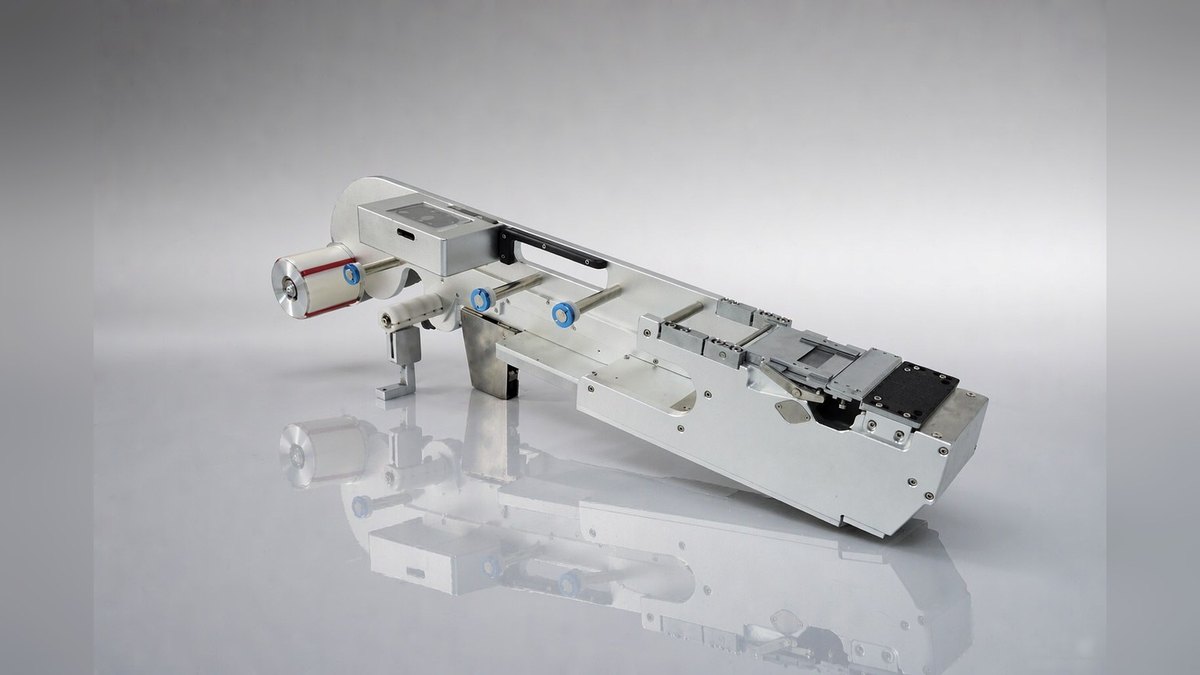
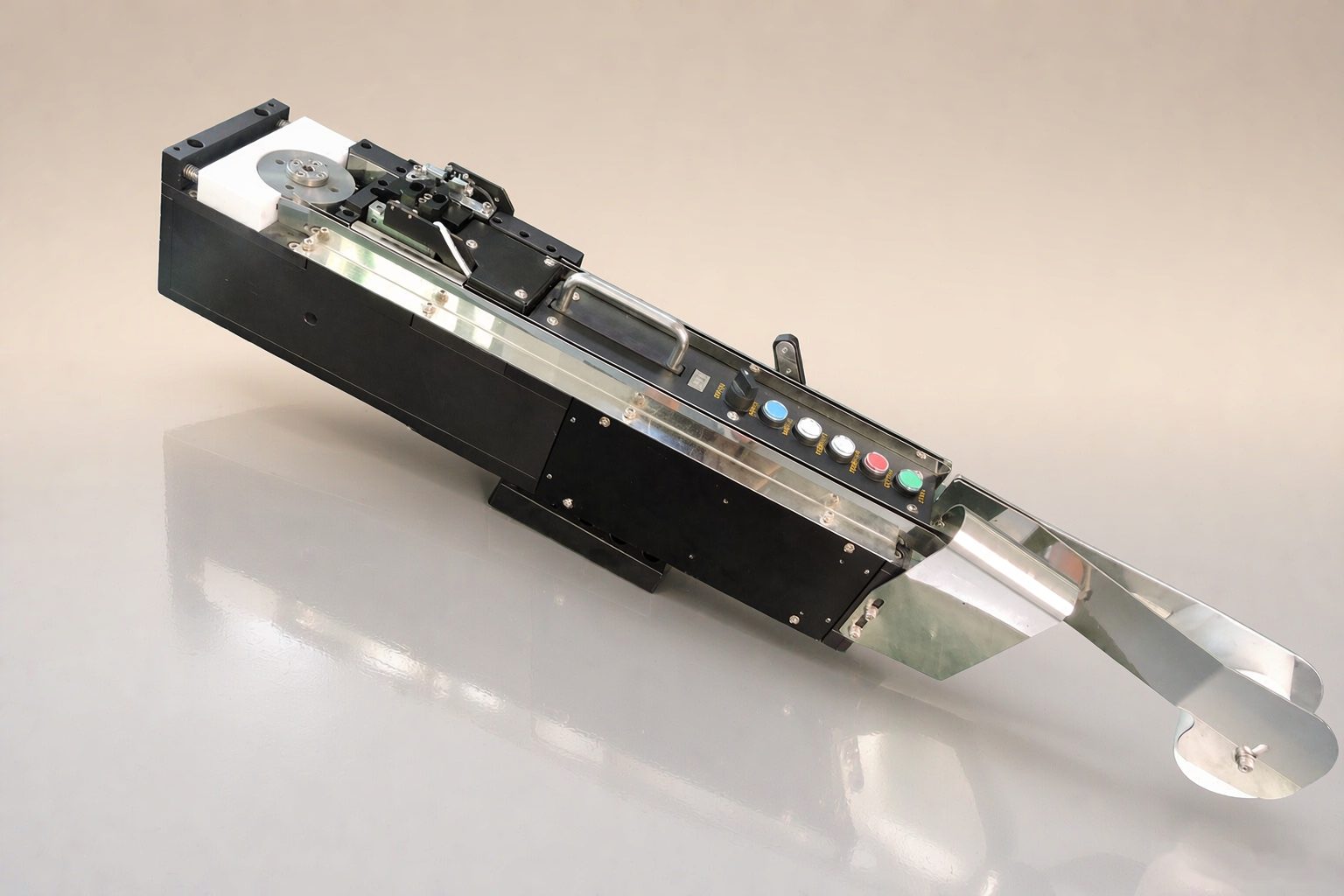
From the product brochure
These are the manufacturer’s own bullet points for this range.
- Works with a placement machine or automation equipment for label stripping
- Touch panel control, English and Chinese
- Single-column and multi-column material
- Non-standard builds supported
Specifications
| Item | Specification |
|---|---|
| Positioning accuracy | ±0.2 mm |
| Feeding speed | 1–100, adjustable |
| Angle accuracy | ±0.5° |
| Position adjustment | Fiber sensor + touch panel |
| Feeding cycle | 0.1–2 s |
| Stripping method | Forward push stripping |
| Supply voltage | DC 24 V |
| Supply current | 80 mA average; 1 A peak |
| Drive motor | Servo motor |
| Suitable material | Labels, metal pieces, foam, thermal pads |
| Production counter | 0–9,999,999 cycles |
| Body material | Hard aluminium + steel parts, surface finished |
| Anti-stick platform | PTFE coated; white or red silicone optional |
| Warranty | One year |
Model selection
| Model | L×W×H (mm) | Weight (kg) | Backing paper length (mm) | Peeling width (mm) | Magazine depth (mm) |
|---|---|---|---|---|---|
| PLF-100 | 970*260*260 | 40 | 50~230 | ≤105 | 150 |
| PLF-200 | 970*320*260 | 50 | 50~300 | ≤200 | 150 |
| PLF-300 | 970*483*260 | 60 | 50~350 | ≤300 | 150 |
Notes
- Feeding cycle is 2–3 s, a different quantity from the reel-fed range’s 0.1–2 s.
- The selection table has no fibre-sensor column: sheet models are specified by backing-paper length, peeling width and magazine depth instead.
- Magazine depth is 150 mm across the three models.
- The three models differ in backing-paper length (50–230 / 50–300 / 50–350 mm) and peeling width (up to 105 / 200 / 300 mm), which is what drives the choice.
Frequently Asked Questions
When should I use a sheet label feeder instead of a reel feeder?
Use the PLF sheet label feeder when the material arrives as die-cut sheets on backing paper, or when the part cannot practically be re-reeled. It carries a magazine rather than a reel spindle and is driven by a combination of electric and pneumatic motion. It can run standalone or linked to a line.
What are the PLF sheet label feeder model differences?
The three PLF models differ in backing-paper length, 50–230 mm, 50–300 mm and 50–350 mm, and in peeling width, up to 105 mm, 200 mm and 300 mm. Magazine depth is 150 mm on all three. Backing-paper length is the first constraint, because a sheet longer than the model accepts cannot be fed.
How fast is a sheet label feeder compared with a reel feeder?
The sheet label feeder runs a 2–3 s feeding cycle, while the reel-fed label feeder range is quoted at 0.1–2 s. The two figures are not directly comparable as throughput: the reel figure is the feed cycle of a reel-fed unit and the sheet figure describes its own feeding cycle. Reel feeding is the faster path when material comes on roll.