
Conclusion
Stiffener steel sheets and Mylar for flexible boards were previously applied manually: tweezers to pick, visual alignment, and any warp in the thin sheet meant it wouldn’t lay flat. After installing the LFJUKI-100 on the JUKI placement machine, steel sheets and components run on the same placement program; peeling, picking, and placing are performed by the equipment, and position is determined by the program rather than by hand steadiness.
Production line and the original labeling method
This factory makes flexible board assemblies on a JUKI placement machine line, with two product types: light bar boards with stiffener steel sheets, and module boards with Mylar isolation. Stiffener steel sheets come in rolls, with individual pieces from a few millimeters to over twenty millimeters, and thickness in the tenths of a millimeter; Mylar is thinner and must be applied flat without bubbles.
The original approach was a separate station after placement, where two operators used tweezers to peel pieces from the carrier tape and apply them against the silkscreen frame. Steel sheets are hard and thin, prone to bending when peeled and unable to be pressed flat; Mylar is soft and curls at the edge when peeled too fast. Position deviations were caught by visual inspection, and rework meant peeling and reapplying again.
Selection: why the LFJUKI-100
The LFJUKI-100 is a roll label feeder for JUKI models, with a body of 640 × 135 × 160 mm and weight of 7.5 kg, mounted directly on the JUKI feeder bank.
Three parameters match: label width 5–98 mm, covering this factory’s narrow steel sheets of a few millimeters up to wide stiffener pieces of over twenty millimeters; label length L2–40 mm, which also covers Mylar strips; and 1–12 lanes with 1–12 fiber optic sensors, so several materials can be arranged on different lanes within one program, feeding a whole row at once for the placement head to pick in one pass.
The difference between steel sheets and Mylar isn’t size but rigidity. Steel sheets resist deformation and hold their flatness after peeling; Mylar is soft and curls if the peel angle is wrong. One feeder handling both materials relies on setting feed speed separately.
Setup and commissioning
Installation sequence: feeder bank positioning, threading, fiber optic setup, touchscreen parameter adjustment.
The fiber optic step is more critical for thin materials. Steel sheets and Mylar have different carrier paper translucency, so the working setpoint must be calibrated separately, placed above the no-material reading, so the criterion is “material present = light on, no material = light off.” Running both carrier papers on the same setpoint causes Mylar to be judged as empty prematurely and the feeder to feed air.
The three touchscreen parameters are set per material: feed position determines the distance the label stops beyond the peel blade; feed speed is first set for clean peeling, then tuned toward the placement cycle; feed delay is used where the nozzle picks slowly. Steel sheets can run faster; Mylar must run slower, slow enough for the label to fully leave the carrier paper before picking.
During commissioning there was also one case of steel sheets not adhering well; investigation showed it wasn’t the feeder but too short a dwell time for the steel sheet at the pick position after peeling, so the nozzle applied some lateral force when picking. Increasing the delay resolved it.
Changes after installation
The stiffener and Mylar processes were merged from a separate station into the placement program, and the manual placement station was removed. Position is determined by program coordinates, visual inspection rejects fewer deviations, and rework no longer includes the peel-and-reapply step.
Steel sheets and Mylar share one feeder; changeover means changing the program and material, not the equipment. Specific defect rate and cycle time data come from the customer’s own statistical criteria and are not cited here.
FAQ
Are steel sheets considered labels, and can a label feeder handle them? Rolled, carrier-backed, peelable piece materials can all run on a roll feeder; steel sheets and Mylar both fall into this category, and the key is that thickness and rigidity determine feed speed.
Which JUKI series can it mount on? The LFJUKI series corresponds to JUKI feeder banks; other brand models are selected by their respective series, and interfaces are not interchangeable.
What to check first if Mylar won’t lay flat? Check peel speed and delay first, then whether the nozzle pick position is centered on the label; the feeder itself is generally not the main cause.
To verify against your board type, steel sheet specifications, and placement machine model, contact us directly: Kenny Pan · Sales Manager · Phone/WeChat +86 134 2139 1163 · Sales@baxida-tech.com
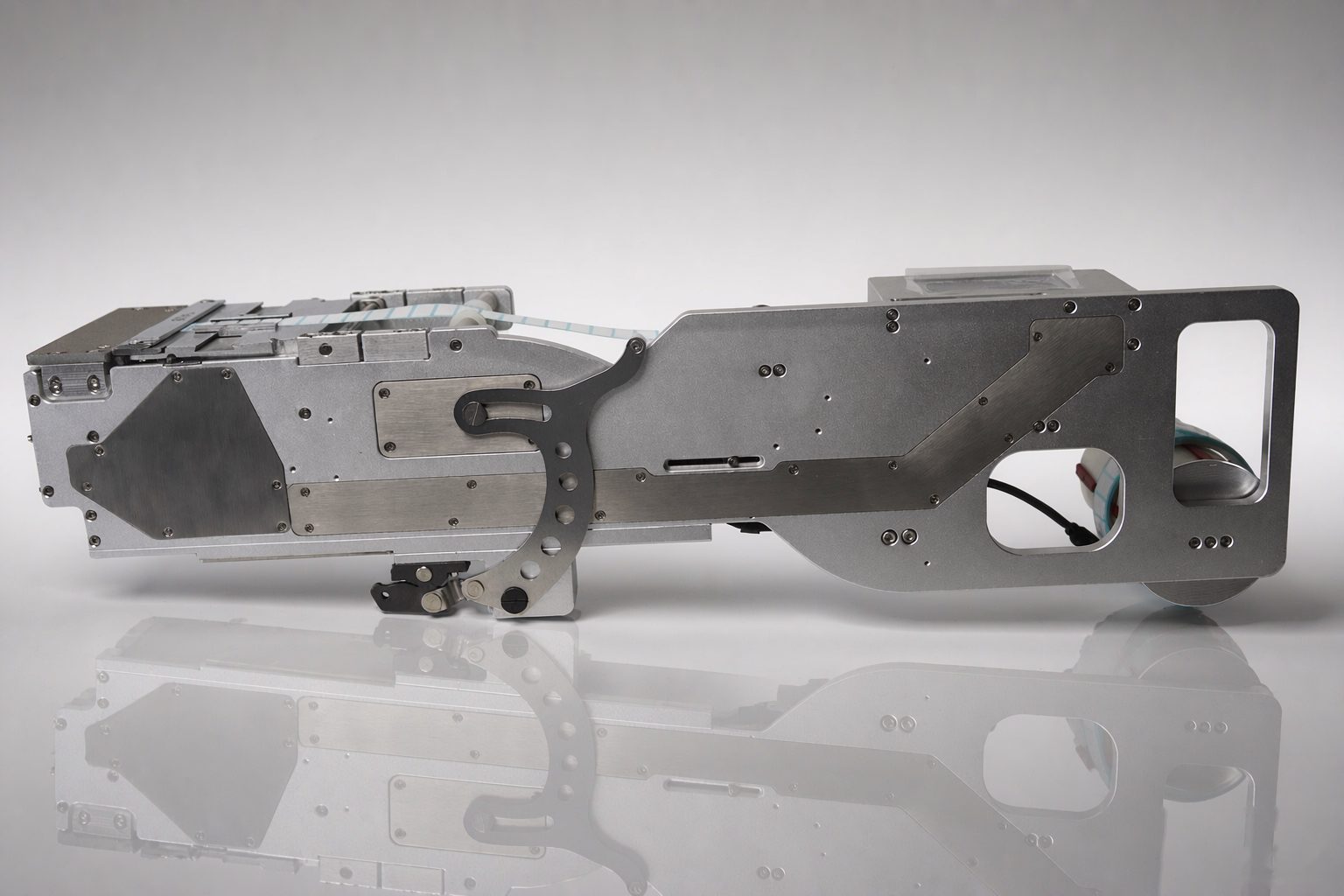
Shop floor photo: label feeder on a JUKI placement machine
This article is compiled from typical configurations of similar production lines; specific parameters and configurations are subject to actual incoming materials and machine models.